
Agriculture 5.0: what are the benefits of using AI to reduce costs and improve labor organization?
November 27
World-class experts will answer such a question. A talk recommended for anyone in the agro industry!
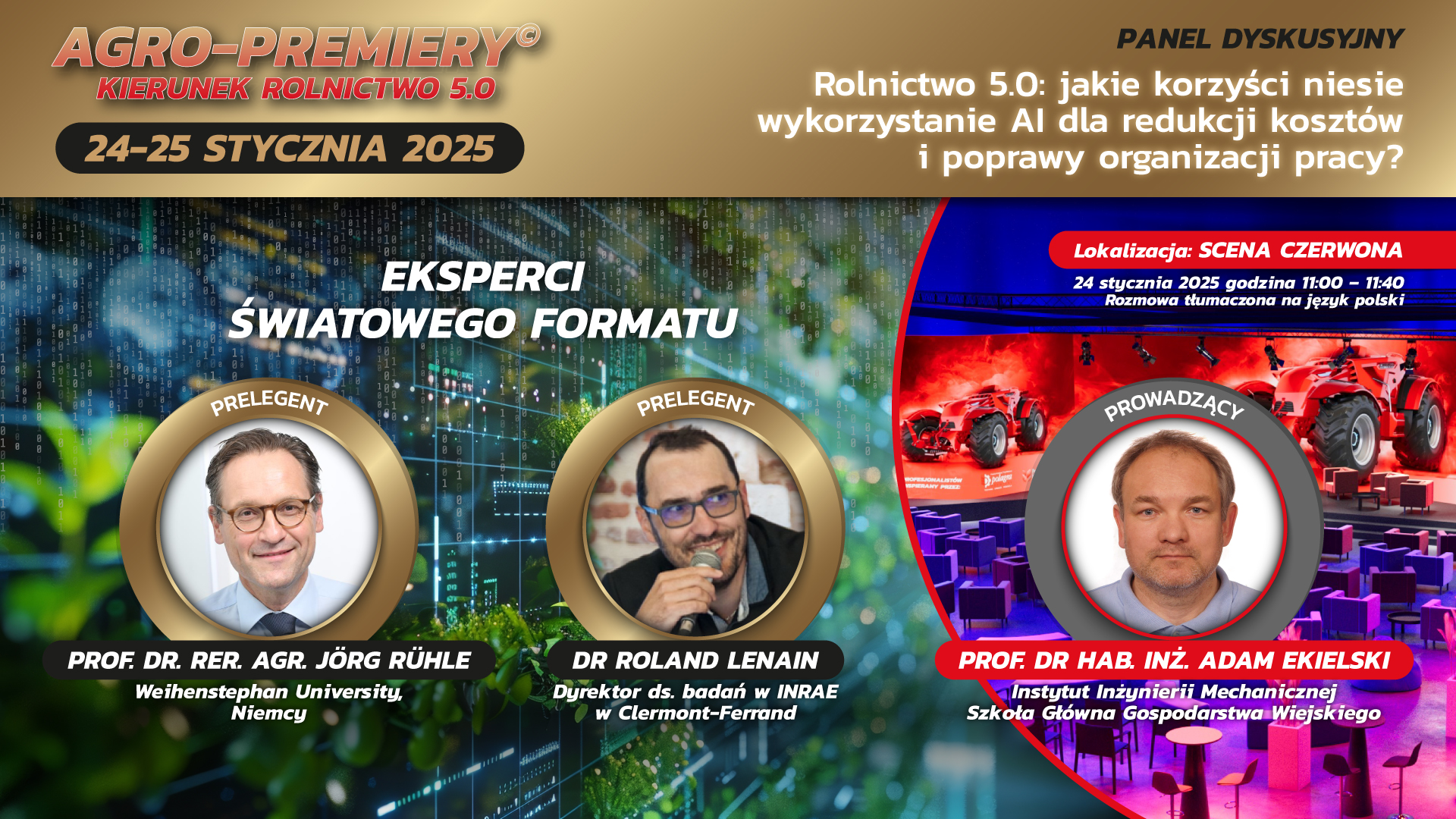
There has never been a meeting like this in Poland before. No one has ever conducted a conversation like this!

You can view the full schedule of panel discussions, where our guests will share their experiences, here:

We cordially invite you to a fascinating discussion on the future of agriculture, titled:
Agriculture 5.0: What benefits does the use of AI bring in terms of cost reduction and improved work organization?
The panelists represent leading European institutes specializing in machine autonomy and the use of artificial intelligence in agriculture. They will discuss the challenges faced by robot and machine designers when planning to grant a mobile machine a certain degree of autonomy. What benefits can the use of artificial intelligence (AI) bring to crop production and livestock production?
Participants in the discussion will include:

Prof. Adam Ekielski is one of Poland’s leading experts in mechanical engineering, specializing in the development of technologies for modern agriculture. His work combines advanced science with practical applications, making him an authority in both academic and industrial circles. He is affiliated with the Institute of Mechanical Engineering at the Warsaw University of Life Sciences (SGGW), where he has been conducting research for many years, leading research teams, and inspiring students as an academic instructor.
Prof. Ekielski is the author of numerous international scientific publications. His work has been cited in prestigious industry and scientific journals, confirming its significance in the global context of agricultural innovation.
His activities extend beyond the university—he actively collaborates with companies in the technology and agricultural sectors, helping to develop new products and systems. He has led numerous research and development projects funded by national and European grants. Thanks to his work, technologies have been implemented that have increased the productivity and environmental sustainability of many farms in Poland and abroad.

Dr. Roland Lenain is currently Director of Research at INRAE (French National Institute for Agriculture, Food, and the Environment) at the TSCF (Information Technologies and Systems) in Clermont-Ferrand. In 2002, he earned a degree in mechanical engineering from the Institute of Advanced Mechanics in France. That same year, he also earned a master’s degree in mechanical and civil engineering.
In 2005, he defended his doctoral dissertation on the autonomous navigation of mobile robots in the field at the University of Clermont-Auvergne (UCA). After completing a postdoctoral fellowship at the Department of Automation at Lund University (Sweden), he joined INRAE (formerly known as Irstea) in 2006.
Roland Lenain has supervised numerous projects and doctoral theses on the control of mobile robots in challenging environmental conditions. In 2011, he obtained his habilitation to conduct scientific research and currently leads the Romea team (Robotics and Mobility for the Environment and Agriculture). He also serves as chair of the scientific committee of the RobAgri association.
His research focuses on adaptive and predictive control of mobile robots in natural environments, with a primary application in the field of agricultural robotics.

Prof. Jörg Rühle is a renowned expert in the field of animal nutrition and feed science. He has extensive professional experience gained over the years in many sectors related to agriculture, animal nutrition, and product development.
His professional career has included a variety of positions in both academia and industry. Among other roles, he worked as a researcher at Martin Luther University in Halle-Wittenberg and held management positions at companies such as DSM Nutritional Products and 365FarmNet Group. His experience includes market development, product management, business development, and leading sales teams, particularly in the areas of ruminant nutrition and innovative feed products.
Since September 2020, he has served as a professor of animal nutrition and feed science at Weihenstephan-Triesdorf University of Applied Sciences.
Prof. Rühle focuses on research and practical solutions in the fields of animal nutrition, feed optimization, and sustainable agriculture. Throughout his career, he has successfully combined scientific work with industry experience, which enables him to implement innovative solutions in practice.
Date: January 24, 2025 (Friday)
Location: Red Stage
Time: 11:00 a.m.–11:40 a.m.
Explore other panel discussion topics:
- Cybersecurity for Industry 4.0 and 5.0: Protect Farm Data and Machinery
- Trends in Animal Production Based on Agriculture 4.0/5.0 Technologies—Hear What the Experts Have to Say
- Why Regenerative Agriculture? Experiences from Practitioners – Top Farms and Goodvalley. Find out with us what experts in this field have to say
- Agricultural contracts: grains, oilseeds, and protein crops. What is the global market looking for?
- Water is a minimum requirement in agriculture. What do advances in breeding and regenerative farming offer to counteract the effects of drought?
- From satellites to plowed fields: Precision Agriculture Made in Poland
- Digital Future and Autonomy in Self-Driving Vehicles for Agriculture
- How to Improve Data Exchange Between Machines and Farms?
- Does a tillage and seeding combination need an application map?
- Will there be funding for Agriculture 4.0?
- Satellite monitoring of crops and soil: precision agriculture and farm economics